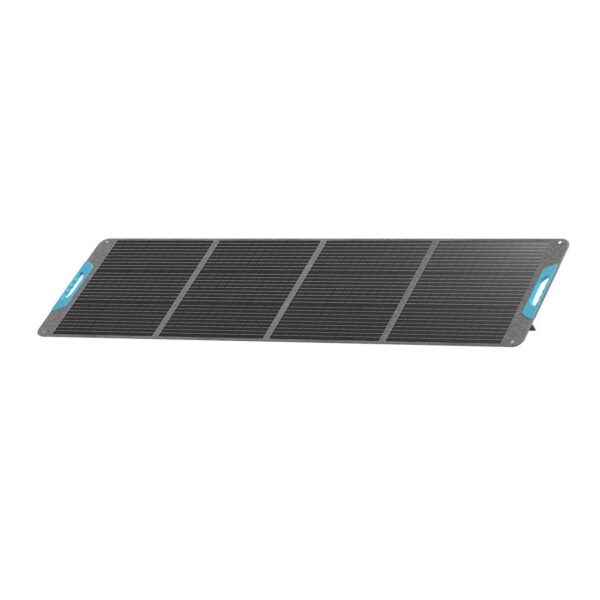
This is Renogy’s E.Flex portable panel in its N-type generation, supplied as two 200 W panels that together make the 400 W in the listing. It is the straightforward way to put a day’s charge back into a power station without touching the mains: unfold, prop it on its kickstands, point it at the sun and plug it in. Each panel is a four-section fold with an integrated handle, so one person can carry and set up both without help.
Key features
- N-type cells that Renogy rates at over 25% conversion efficiency, so more watts come off the same surface area
- Folds to 23.72 in with an integrated carry handle, and opens to 87.8 in of collecting surface per panel
- Adjustable kickstands to angle the panel towards the sun, which in practice affects the day’s yield more than any figure on the box
- IP65 rating against dust and splashing water, so an afternoon shower is not a reason to pack up
- Multiple output ports, so small devices can be charged directly as well as through a power station
- Panels can be wired in series or in parallel to suit the charge controller or station they feed
Specifications
- Rated power 200 W per panel at standard test conditions, 400 W for the pair
- Open-circuit voltage 21.6 V; short-circuit current 11.3 A; optimum operating point 18.8 V at 10.6 A
- Folded 23.72 x 22.99 x 1.97 in (602.5 x 584 x 50 mm); unfolded 87.80 x 22.99 x 0.12 in (2,230 x 584 x 3 mm)
- Weight 13.89 lb (6.3 kg) per panel
- Ingress protection IP65; operating temperature 14°F to 149°F (-10°C to +65°C)
- Renogy SKU RPP200EF-SE-G2-US; two-year material and workmanship warranty
The honest caveat on any solar panel is the rating itself. The 400 W is measured at standard test conditions, which means full sun striking the panel square on at a cell temperature of 25°C. Outdoors the number is lower and often a great deal lower: thin cloud, haze, dust on the surface, heat, and any angle away from the sun all cut the yield, and a panel lying flat on the ground collects far less than one propped towards it. Plan around a realistic daily figure in watt-hours, not the rating. Two practical points as well: check that the open-circuit voltage, 21.6 V per panel and more again if you wire them in series, stays inside the DC input limit of the power station you are feeding, and remember that charging a battery bank directly needs a charge controller, which is not part of this set.