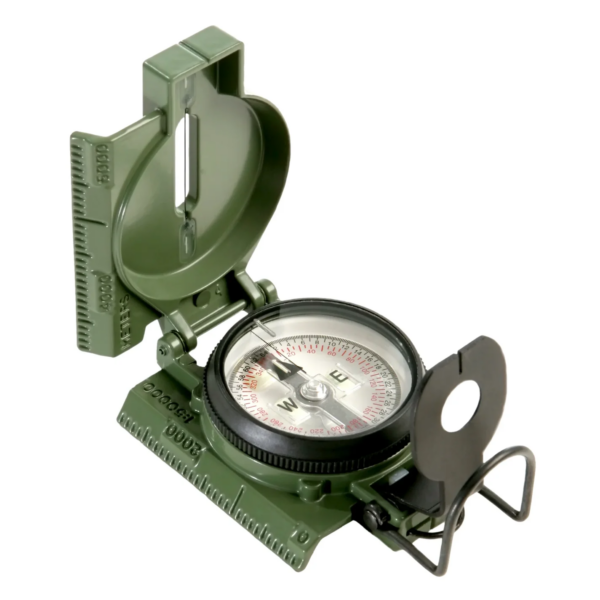
The Cammenga Model 3H is the issue lensatic compass of the United States armed forces, made in Michigan to the military specification MIL-PRF-10436N. It is a tool for taking a bearing on a distant feature and walking it, and for working with the grid and declination printed on topographic maps. Where an electronic unit eventually meets a flat cell or a cracked screen, this one has no power source at all, and that is the reason it belongs in a preparedness kit rather than only in a soldier’s pocket.
Key features
- Seven self-luminous tritium micro-lights read the dial in the dark with no charging, no torch and no battery
- Copper induction damping settles the needle quickly without liquid in the capsule, so nothing freezes and no bubble forms
- Dial graduated in both degrees and mils, read through the folding magnifying lens on the rear sight
- Sighting wire in the lid and a rear sight slot, so a bearing can be taken on a distant feature rather than estimated
- Cast aluminium frame with a sealed housing: shockproof, waterproof and sandproof
- Supplied with a carrying pouch, lanyard and belt clip
Specifications
- Made in the USA to the United States military lensatic specification MIL-PRF-10436N
- Illumination: seven tritium micro-lights, self-luminous, nothing to charge
- Damping: copper induction ring, no liquid in the capsule
- Dial graduations: degrees and mils
- Working temperature range: -50 to +150 degrees Fahrenheit (about -46 to +66 degrees Celsius)
- Needle balancing: northern hemisphere; Cammenga lists a separate 3HSH for the southern hemisphere
It suits anyone who navigates from paper topographic maps and wants an instrument that will still work after a decade in a drawer. Three honest points before you choose it. A military lensatic compass has no declination screw, so you read the declination figure off your map and apply it to every bearing yourself, by arithmetic, each time; a baseplate compass with an adjuster is easier on this count. Tritium glows by radioactive decay, which means it cannot be recharged and dims gradually over years, so an old compass is a dimmer one. And this standard model is balanced for the northern hemisphere: carried far south of the equator the needle will drag against the capsule and read poorly.