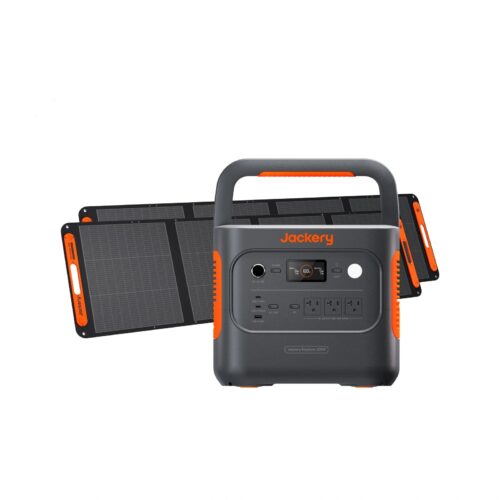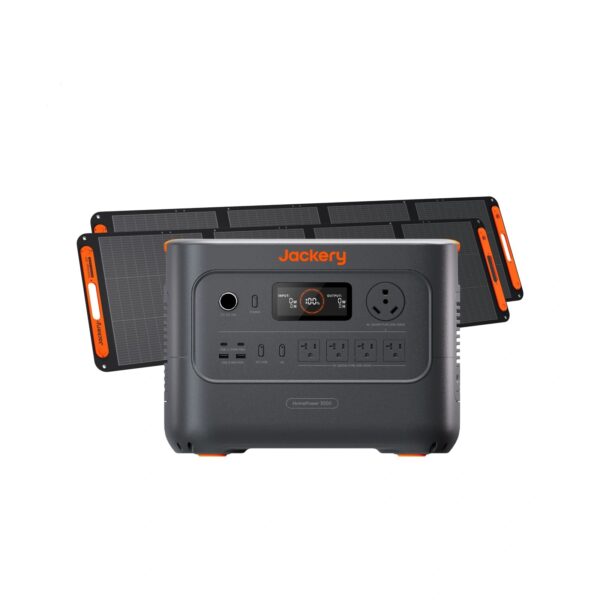
The HomePower 3000 sits at the home-backup end of Jackery’s range. It holds 3,072 watt-hours and delivers 3,600W continuously, with five AC outlets including a 30A TT-30 socket of the sort a caravan or recreational vehicle uses. A cell-to-body structure keeps it to a 16in-wide case, though at about 59.5lb it is a two-handed lift rather than something to carry far. This kit adds two SolarSaga 200W folding panels for charging away from the grid.
Key features
- 3,072Wh of lithium iron phosphate with 3,600W of continuous output and 7,200W of surge, enough headroom for motors that spike as they start.
- Four 120V 20A outlets, each good for up to 2,400W, plus one 120V 30A TT-30 socket; also two 100W USB-C ports, two 18W USB-A ports and a 12V/10A car socket.
- Paired with a manual transfer switch it can carry up to six essential household circuits while the grid is down.
- Uninterruptible supply with a switchover under 20 milliseconds, and a full mains recharge in 2.2 hours, or 1.7 hours combining mains and solar.
- Jackery rates the cells at 4,000 charge cycles to 70 per cent or more of original capacity, and the unit holds roughly 95 per cent of its charge after twelve months in storage.
- Two bifacial SolarSaga 200W panels, TOPCon cells at around 25 per cent conversion, rated IP68 and usable from -10°C to 65°C.
Specifications
- Capacity: 60Ah / 51.2V DC (3,072Wh); cell chemistry LiFePO4
- Rated cycle life: 4,000 cycles to 70 per cent or more of capacity
- AC output: 3,600W continuous, 7,200W surge peak
- Outlets: four 120V/20A plus one 120V/30A TT-30
- Charging: 2.2 hours from the mains, 1.7 hours on mains and solar together; UPS switchover under 20ms
- Dimensions and weight: 16.4 x 12.8 x 12in, about 59.5lb (27kg); charge 0°C to 45°C, discharge -15°C to 45°C
Three caveats. The six-circuit arrangement needs a manual transfer switch, which is not in the box, and wiring one to a consumer unit is a job for a licensed electrician rather than an afternoon’s work. The HomePower 3000 is a standalone system with no expansion batteries, so 3,072Wh is the whole of it. And that figure is what the cells hold, not what reaches an appliance. In practice 3,600W will carry a fridge, lights, a router and a few small appliances comfortably; it will not carry a whole house with electric heating or an electric cooker, and sizing it against the circuits you actually need is worth doing before you buy.