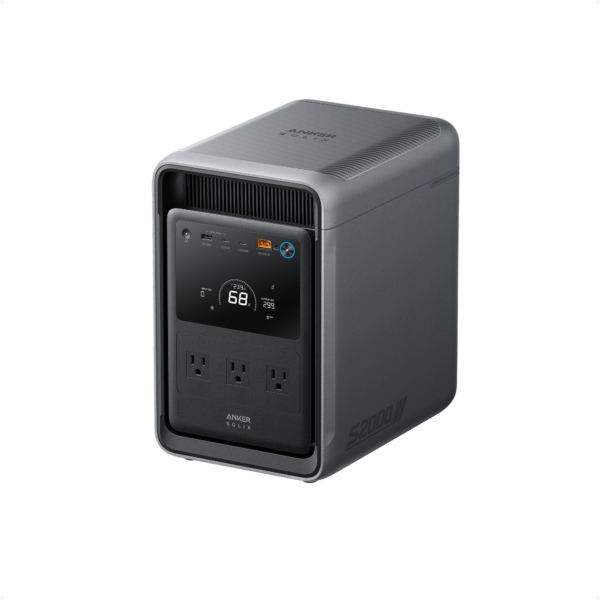
The SOLIX S2000 carries 2,010 watt-hours in an unusually compact upright case weighing 35.7lb, which is light for two kilowatt-hours. What sets it apart is longevity rather than raw output: Anker rates its 314Ah lithium iron phosphate cells at 6,000 charge cycles to 80 per cent of their original capacity, about twice what this size of unit usually offers. That suits a household buying one unit to sit in a cupboard for years and earn its keep when the power goes. This listing is the version supplied with a power strip.
Key features
- 2,010Wh of LFP capacity from 314Ah cells, rated at 6,000 cycles to 80 per cent of original capacity and 10,000 cycles to 60 per cent.
- 1,500W of continuous pure sine wave output, with 3,000W of peak headroom for the brief surge a fridge or pump draws as it starts.
- Eight output ports in all; the front panel carries three AC outlets, a charge display and USB-A and USB-C sockets.
- Switches over in 10 milliseconds as an uninterruptible supply, so a desktop, router or network drive plugged through it stays up when the grid drops.
- Up to 400W of solar input and up to 1,600W from a mains socket.
- 8.2 x 11.1 x 12.7in, quiet enough to live indoors, and covered by a five-year warranty.
Specifications
- Capacity: 2,010Wh
- Cell chemistry: LFP (lithium iron phosphate), 314Ah cells
- Rated cycle life: 6,000 cycles to 80 per cent of capacity; 10,000 cycles to 60 per cent
- AC output: 1,500W continuous, 3,000W peak, pure sine wave
- Inputs: up to 400W solar, up to 1,600W mains; UPS switchover 10ms
- Dimensions and weight: 8.2 x 11.1 x 12.7in, 35.7lb (16.2kg)
Note the shape of the compromise. There is no 12V car socket on this model and no expansion battery, so 2,010Wh is all you get and it cannot be grown later. The 3,000W figure is surge headroom measured in seconds, not a working ceiling; the number to plan against is 1,500W, which rules out a kettle and a microwave at the same time. And the stated capacity is what the cells hold rather than what arrives at the socket, so expect somewhat less in use. This backs the appliances you choose to plug into it, not a house.