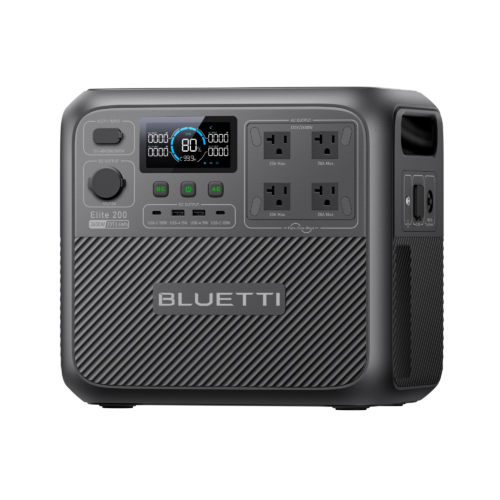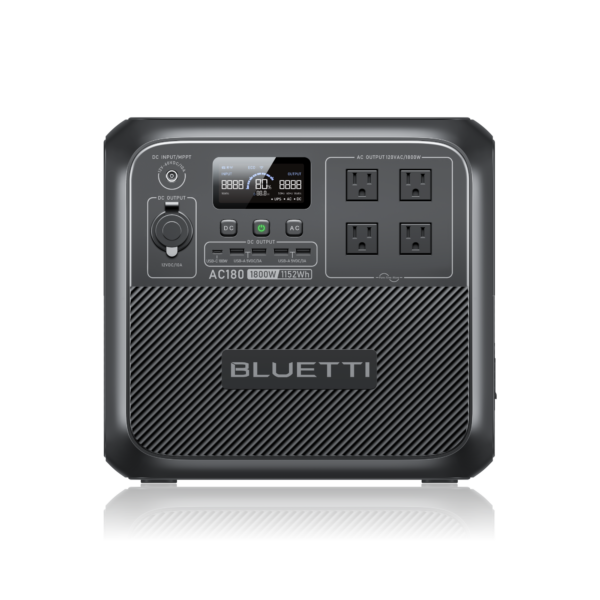
The AC180 is BLUETTI’s middle rung: 1,152 watt-hours of lithium iron phosphate behind an 1,800W pure sine wave inverter, in a 16kg case with a folding handle. This is the capacity class that suits most households. It is enough to keep a fridge, a router, lights and phones running through a long evening outage, and it has enough outlets that nobody is sharing an adapter.
Key features
- Four 120V 15A outlets sharing 1,800W of pure sine wave output, which is a clean enough waveform for laptops and fridge compressors alike.
- Nine outputs in total, including a 100W USB-C port and a 12V DC socket.
- Power Lifting Mode raises the ceiling to 2,700W for heating loads such as a space heater, hair dryer or electric blanket.
- Four ways to recharge, from the mains, solar, a car socket or a petrol generator, with 0 to 80 per cent in 45 minutes on a 1,440W mains input.
- Up to 500W of solar input, which BLUETTI says fills it in about three hours in good sun.
- LiFePO4 cells rated at more than 3,500 cycles to 80 per cent of original capacity, with a five-year warranty.
Specifications
- Capacity: 1,152Wh
- Cell chemistry: LiFePO4 (lithium iron phosphate)
- Rated cycle life: 3,500+ cycles to 80 per cent of original capacity
- AC output: 1,800W continuous, pure sine wave, across four 120V/15A outlets; 2,700W in Power Lifting Mode
- Inputs: up to 500W solar, up to 1,440W from the mains
- Dimensions and weight: 340 x 247 x 317mm (13.4 x 9.7 x 12.5in), about 16kg (35.3lb)
Two things are worth knowing before you buy. Power Lifting Mode is for resistive heating only: BLUETTI states plainly that it must not be used to run an air conditioner or a washing machine, because the trick it uses to reach 2,700W does a motor no favours. And the 1,152Wh rating describes what the cells hold, not what reaches the socket, since the inverter takes its share on the way through. Within those limits, this is a sound choice for a household that wants one unit to carry the essentials through a day without power.