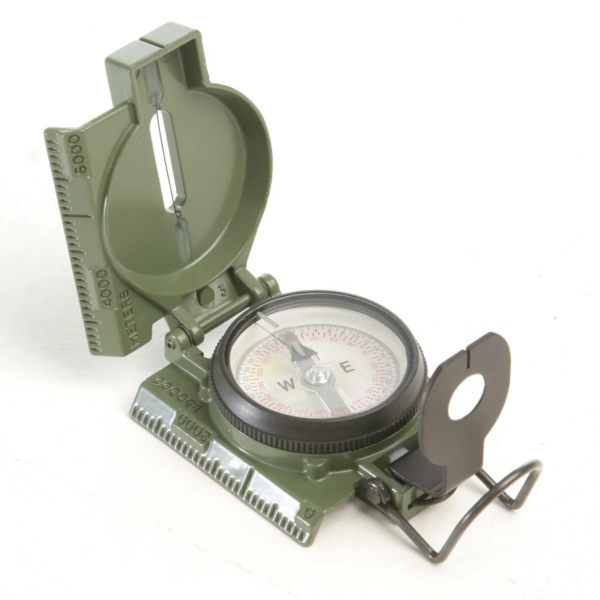
The Model 27 is Cammenga’s lensatic compass for people who want the military body without the tritium. Everything that makes the issue compass durable is here, including the copper induction damping and the sealed aluminium frame, but the dial and index markings are phosphorescent, charged by daylight, a torch or even a phone screen. It is the sensible companion to a set of topographic maps, and it needs no batteries, which is why a compass of this kind earns its place in a preparedness kit.
Key features
- The same induction-damped lensatic body Cammenga supplies to the United States military, with phosphorescent markings in place of tritium vials
- Copper induction damping ring settles the needle without liquid, so temperature changes do not shift the reading or raise a bubble
- Phosphorescent dial charges from sunlight or any light source for night reading
- Sighting wire, rear sight slot and folding magnifying lens for taking and reading a bearing
- Powder-coated aluminium frame: shockproof, sandproof and waterproof to considerable depths
- Supplied with an olive drab nylon pouch, a cord lanyard and a belt clip
Specifications
- Accuracy: plus or minus 40 mils
- Damping: copper induction ring, no liquid in the capsule
- Dial graduations: degrees and mils
- Working temperature range: -50 to +150 degrees Fahrenheit (about -46 to +66 degrees Celsius)
- Dimensions closed: 3 1/4 x 2 1/4 x 1 1/4 inches (about 83 x 57 x 32 mm)
- Made in the USA; northern and southern hemisphere versions are produced, so check which one you are ordering
This suits someone who wants the military lensatic compass and is content to charge the glow rather than have it supplied by physics. The honest trade is exactly that: phosphorescent paint has to be exposed to light first and fades over the hours that follow, so by the small hours you will be reaching for a torch, whereas the tritium 3H simply glows. Like every military lensatic, it has no declination adjuster, so you correct each bearing yourself using the declination figure printed on your map. And the hemisphere matters: a northern-hemisphere compass will not settle properly deep in the south.