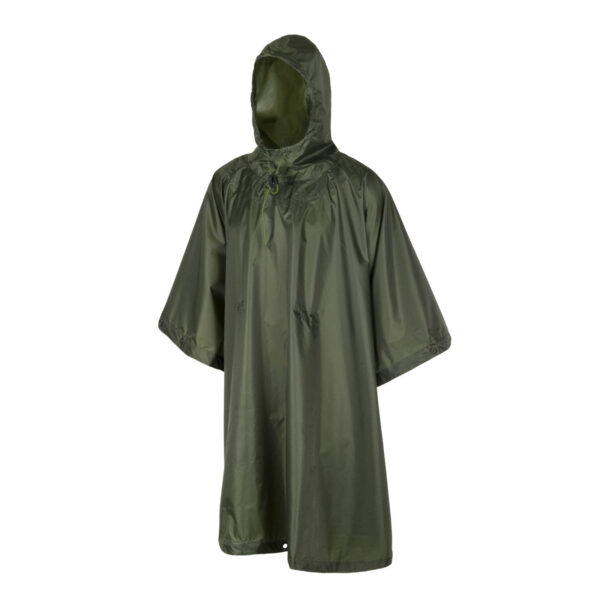
Helikon-Tex, based in Wroclaw in Poland, makes this as part of its Surplus Line: civilian copies of well-known military patterns. The US Model poncho follows the issue shape and is generously cut, so it goes on over clothing and a medium-sized rucksack at once rather than leaving your pack out in the rain. At roughly 469 grams and rolled down to the size of a water bottle, it is light enough to leave permanently in a pack or pannier.
Key features
- Ripstop weave stops a snag spreading into a tear
- Taped seams and a drawcord-adjustable hood
- Press studs along the sides form rough sleeves, or close the poncho against wind
- Metal eyelets at the edges take guy lines for use as a tarp or lean-to
- Two ponchos can be joined with the studs to make a larger canopy
- Carry bag included, and the poncho can be stabilised with a dedicated cord
Specifications
- Fabric: 100% polyester ripstop, 72 g/m2
- Open dimensions: 210 x 145 cm (82.7 x 57.1 in)
- Weight: approximately 469 g (1.09 lb)
- Rolled size: 21 x 14 x 3 cm, in the bag supplied
- Fit: one size, loose cut
- Part number: PO-MUS-PO; made by Entire M sp. z o.o., Poland
This suits walkers, cyclists and anyone who wants rain cover that also works as shelter material. Be aware of two things. Helikon-Tex’s own care label says do not wash, tumble dry, iron or dry clean it, so cleaning means sponging it down and hanging it to dry. And a poncho is open at the sides by design: the press studs help, but in driven rain and wind you will take water at the flanks and from below in a way a fitted jacket would not. It is at its best in steady vertical rain and as a piece of improvised shelter, which is also where the eyelets earn their keep.