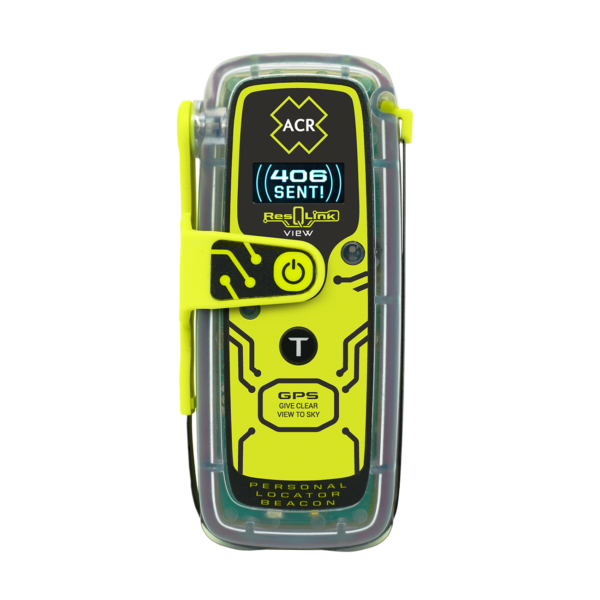
A personal locator beacon does one thing and does it without a network: when you deploy the antenna and hold the button, it transmits a 406 MHz distress signal carrying your identity and your GNSS position to the Cospas-Sarsat satellites, which route it to the rescue co-ordination centre for wherever you are. There is no mobile coverage involved and no account to keep paid up. What the View adds over the plain ResQLink is a display, so you can see the beacon acquire its position, confirm the alert has gone, and read back your own coordinates — useful if you later reach someone by radio or phone.
Key features
- No subscription or airtime plan for the distress function — registration with the national authority is free
- 406 MHz distress alerting through the global Cospas-Sarsat satellite system, with 121.5 MHz homing for the final approach
- Multi-constellation GNSS receiver using GPS and Galileo
- Digital display showing beacon status, transmission confirmation and latitude and longitude
- Buoyant body with visible and infrared strobes
- Self-test function so you can confirm the beacon is working before a trip
Specifications
- Dimensions: 11.48 x 5.16 x 3.78 cm (4.52 x 2.03 x 1.49 in)
- Weight: 148 g (0.33 lb)
- Operational life: 28 hours (manufacturer figure, from accredited laboratory testing)
- Waterproof: 5 m for 1 hour, 10 m for 10 minutes
- Battery replacement: after five years or after any activation, whichever comes first
- Approvals: Cospas-Sarsat, FCC, Europe RED
This is for people who travel beyond mobile coverage — offshore, backcountry, remote roads, light aircraft — and want a last-resort call for help that does not depend on a paid plan. Be clear about the trade-off, because it is the whole decision. A beacon is one-way: it cannot send a message, share your route with anyone at home, or tell them you are safe. Satellite communicators such as the Garmin inReach or ZOLEO do all of that, but they only work while an airtime subscription is active. This does not need one, and in the United States you must register it — free — with NOAA, and re-register every two years. Activate it only in a grave emergency. The battery is not user-replaceable; it goes to an approved service centre at five years, or after any activation, even an accidental one.