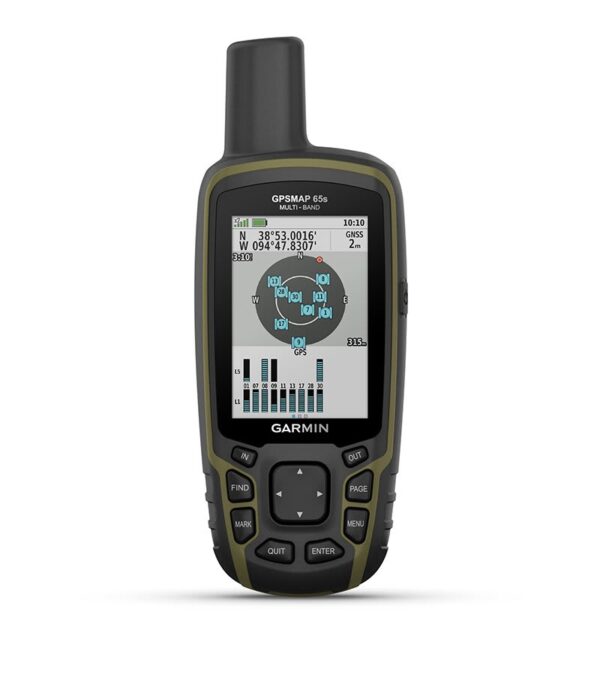
The GPSMAP 65s is the step up from a basic handheld for people who want position accuracy they can rely on under tree cover and in steep valleys. It was part of Garmin’s first handheld series to receive more than one satellite frequency, adding the L5 signal to L1, which is what helps most where signals arrive reflected or weakened. It is operated by buttons rather than a touchscreen, so it works with cold hands and gloves, and it takes two AA cells, so a spare pair in a pocket is the whole charging strategy.
Key features
- Multi-band reception plus expanded constellation support across GPS, GLONASS, Galileo and QZSS
- Button-operated, with a sunlight-readable 2.6-inch colour display and a quad helix antenna
- Preloaded routable TopoActive mapping for the United States and Canada, with public land boundaries
- Barometric altimeter and tilt-compensated three-axis compass, which the plain GPSMAP 65 lacks
- Runs on two AA batteries, swappable in the field; 16 GB internal memory plus a microSD slot
- Pairs with the Garmin Explore app for planning routes and syncing waypoints and tracks
Specifications
- Dimensions and weight: 6.1 x 16.0 x 3.6 cm; 217 g with batteries
- Display: 2.6 inch diagonal, 160 x 240 pixels, transflective 65K colour TFT
- Battery: two AA cells, not included, NiMH or lithium recommended; 16 hours in GPS mode
- Water rating: IPX7
- Memory: 16 GB internal, microSD to 32 GB; 5,000 waypoints, 200 routes, 10,000-point track log
- In the box: GPSMAP 65s, carabiner clip, USB cable and documentation
Two things to set expectations on. Running several constellations and both frequencies draws more current than plain GPS, so the 16-hour figure is a ceiling rather than a promise, and the batteries are not supplied. IPX7 means it survives incidental immersion to one metre for half an hour, not that you can swim with it. The display is sunlight-readable rather than sharp, which is the right priority for a field instrument but will look coarse next to a phone. And a receiver is a complement to map and compass, not a replacement: carry the paper sheet for the ground you are on and know how to use it.