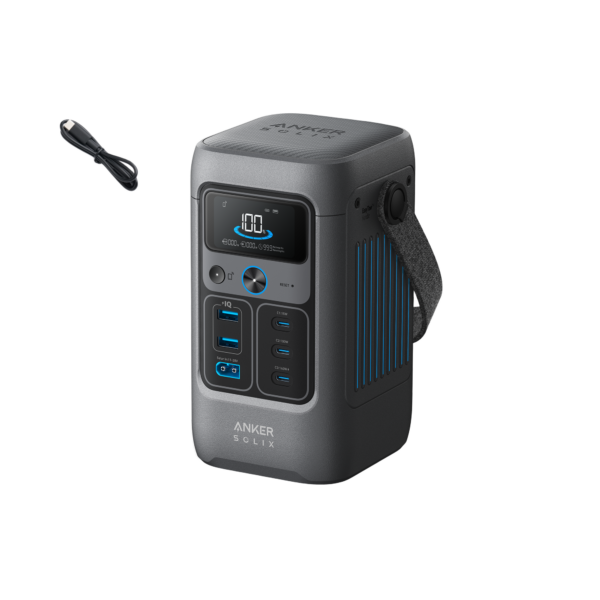
The SOLIX C200 DC is the smallest power station Anker makes: 192 watt-hours of lithium iron phosphate in a block about the size of a large vacuum flask, with a webbing carry strap on one side. It is built for the person who wants several days of phone, headtorch, tablet and camera charging in a go-bag, a car boot or a tent, and who does not need a mains socket to come with it.
Key features
- Five outputs sharing a 200W total ceiling: USB-C ports rated at 140W, 100W and 15W, plus two 12W USB-A ports.
- The 140W USB-C port works in both directions, so the same socket that fast-charges a laptop also recharges the unit.
- An XT60 input takes up to 100W of solar at 11 to 28 volts, for topping up away from the grid.
- Lithium iron phosphate cells, which Anker rates at more than 3,000 charge cycles to 80 per cent of their original capacity.
- Wi-Fi and Bluetooth with Anker’s app, so the charge level and draw can be read without unpacking it.
- 1.9kg and 185mm tall, which is light enough to carry all day and small enough to sit in a glovebox.
Specifications
- Capacity: 192Wh
- Cell chemistry: LiFePO4 (lithium iron phosphate)
- Rated cycle life: 3,000+ cycles to 80 per cent of original capacity
- Output: 200W maximum across five ports; no AC outlet and no 12V car socket
- Recharging: USB-C up to 140W, reaching 80 per cent in about 1.3 hours, or XT60 solar up to 100W
- Dimensions and weight: 100 x 110 x 185mm, 1.9kg; operating range -20°C to 40°C
Be clear about what this is. It is a DC unit with no inverter, so it will not run a lamp, a kettle or any other mains appliance, and there is no cigarette-lighter socket either. No mains charger is supplied, so you need your own USB-C adapter, and a 140W one to recharge at full speed. The 192Wh figure is what the cells hold, not what arrives at a device: conversion losses take a share, so plan on rather less in practice. Taken for what it is, a large and long-lived USB battery, it is a good piece of kit; if you need mains sockets, choose a unit with an inverter.