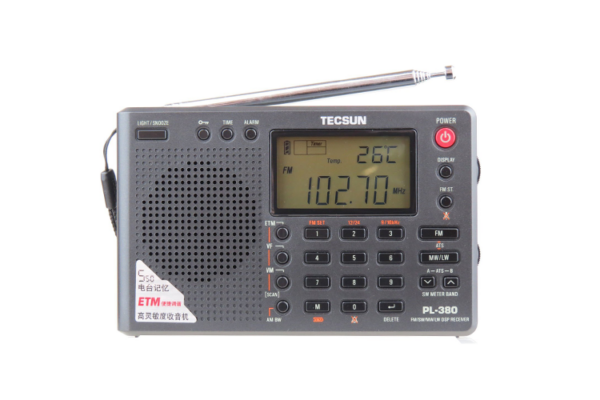
The PL-380 is a pocket shortwave radio built around a Silicon Labs DSP receiver chip, which gives a set this small far better sensitivity and selectivity than the analogue pocket radios it sits beside on the shelf. For a preparedness kit its best feature is mundane: it runs on three AA cells, the same batteries as a torch, rather than a sealed pack that will be flat and unreplaceable in five years.
Key features
- Silicon Labs Si4734 digital signal processing, for sensitivity and station separation that a pocket analogue set cannot reach
- Five selectable AM filter widths — 6, 4, 3, 2 and 1 kHz — to cut interference from a station on the next channel
- ETM easy tuning mode: one sweep stores everything audible from where you are standing, without disturbing the memories you saved
- 550 memories, automatic tuning storage and direct frequency entry from the keypad
- Runs on three AA cells, so it takes the batteries you already keep for torches
- Clock, alarm, snooze, sleep timer, backlit display and a keylock; supplied with a carry case, earphones and a wire aerial
Specifications
- Shortwave 2300–21950 kHz; medium wave 522–1620 kHz, switchable to the 520–1710 kHz and 10 kHz step used in the United States; long wave 153–513 kHz
- FM 87–108 MHz, with 64–108, 76–108 and 87.5–108 MHz settings selectable
- Power: three AA cells (UM3)
- 135 x 86 x 26 mm; 200 g without batteries
- Receiver: Silicon Labs Si4734 DSP, with AM filter widths of 6 / 4 / 3 / 2 / 1 kHz
Three honest limits. It has no NOAA weather band — FM stops at 108 MHz and NOAA broadcasts near 162 MHz — so there is no weather alerting and no hand crank, and a dedicated NOAA weather radio still has a place next to it. It has no single sideband, so amateur and utility voice traffic will sound unintelligible. And its shortwave coverage ends at 21950 kHz, which leaves out everything above that, 27 MHz CB included. Within those limits it is a great deal of receiver for its size, and the AA cells are a real advantage when the power is out.