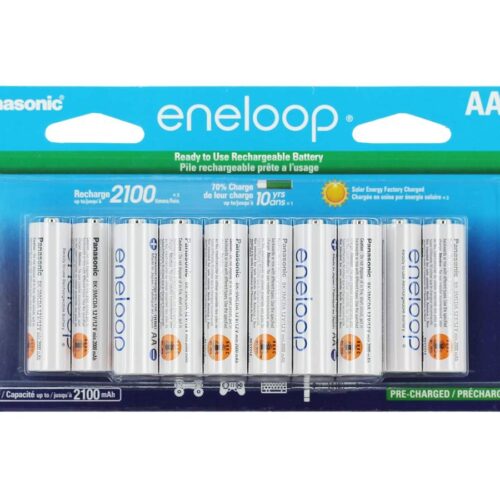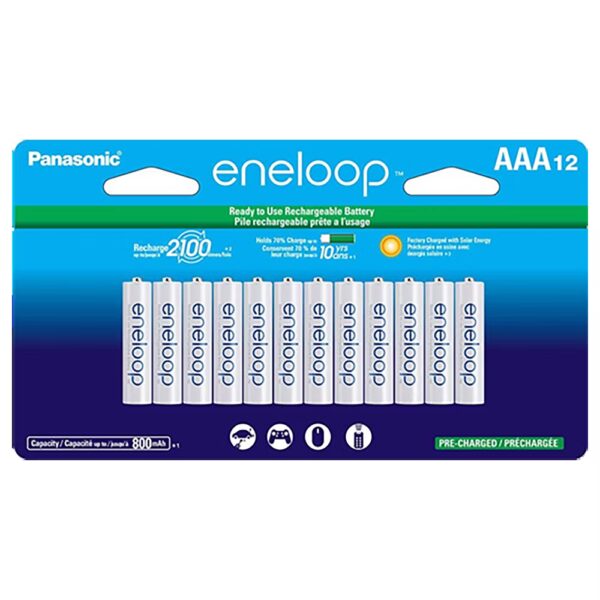
The eneloop is the cell most people settle on once they have been through a few cheap rechargeables. These are AAA, twelve to a pack, and they are low self-discharge: they come charged from the factory, they can be stored for years without going flat, and they can be topped up whether they are half empty or fully drained. For a preparedness store the relevant point is cold performance — eneloops keep delivering at low temperatures, which is exactly when a head torch or a weather radio matters most.
Key features
- Pre-charged at the factory in Japan and ready to use straight out of the pack
- Rechargeable up to 2,100 times, so one cell replaces a long run of disposables
- Low self-discharge: holds up to 70% of its charge after ten years in storage
- Keeps working down to minus 20 degrees Celsius, where many rechargeable cells fade
- Can be recharged fully or partly drained, with no memory effect to manage
- Fits the AAA devices that fill a kit: head torches, weather radios, lanterns and two-way radios
Specifications
- Model BK-4MCCA12FA; 12 x AAA Ni-MH cells
- Nominal voltage: 1.2 V
- Capacity: up to 800 mAh
- Charge cycles: up to 2,100
- Charge retention: up to 70% after 10 years of storage
- Operating range extends to minus 20 degrees Celsius
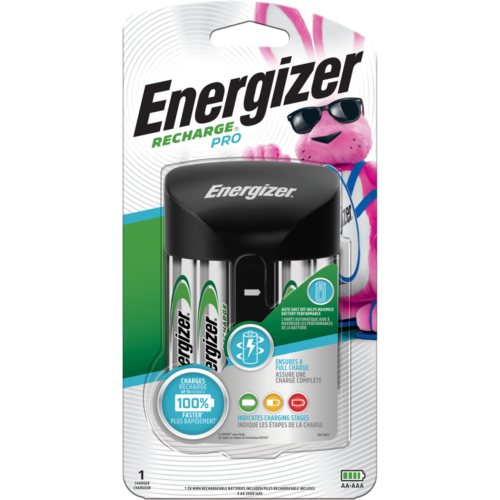
Two honest caveats. A Ni-MH cell sits at 1.2 V rather than the 1.5 V of an alkaline, and a small number of devices with a high low-voltage cut-off will read them as flat while there is still charge left — worth testing in your own kit before you commit to them. And a rechargeable is only as good as your ability to recharge it: no charger is supplied with this pack, and in a long outage you need a plan for putting the charge back, whether that is a power station, a solar panel or a vehicle. Many households keep eneloops for everything they use regularly and hold a small reserve of lithium primaries for the kit that sits untouched.