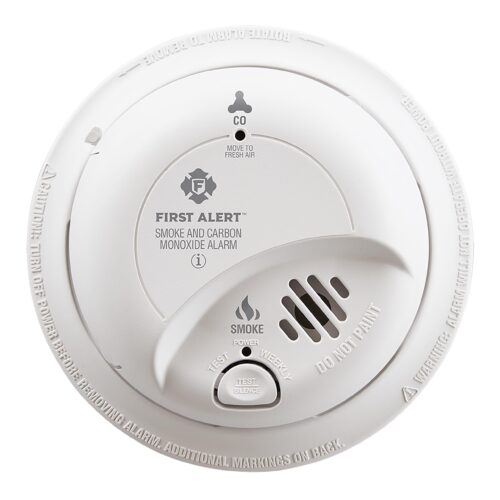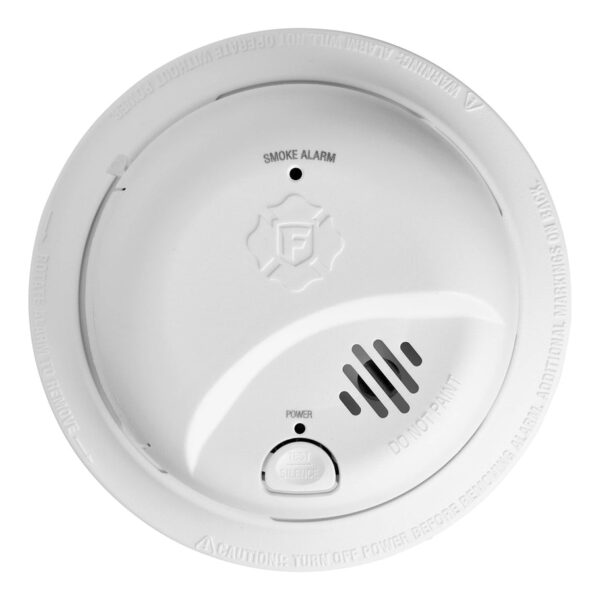
The SMI100 is First Alert’s plain battery-operated smoke alarm, sold here as a pair. It runs on a single 9V battery and needs no wiring at all, which makes it the practical answer for the places a hard-wired system misses: a garage, a loft, a workshop, a rented flat, a spare bedroom, or a cabin with no mains supply at all.
Key features
- Battery-operated, so it mounts on any ceiling with two screws and no electrical work
- Precision Detection sensing, which meets the current industry standard for reducing cooking nuisance alarms
- Front-access battery compartment, so the battery changes without taking the alarm off the ceiling
- Test and silence button on the face for monthly testing and for quieting a false alarm
- End-of-life warning that tells you when the alarm itself needs replacing
- Optional locking features to discourage the battery or the alarm being removed
Specifications
- Model SMI100; ionisation sensor
- Power: one 9V alkaline battery per alarm, user-replaceable
- Sounder: 85 dB at 10 feet
- Size: 5.4 in diameter x 1.9 in deep (13.7 x 4.8 cm); 0.7 lb (about 320 g) each
- Replaces First Alert model SA303
- 10-year limited warranty
This is an ionisation alarm, and First Alert says plainly what that means: ionisation sensing responds faster to fast, flaming fires, while photoelectric sensing responds faster to slow, smouldering ones, and a home is best covered by both technologies rather than either alone. It is also worth saying that a smoke alarm does not detect carbon monoxide — that needs a separate CO alarm. Because it runs on a replaceable battery rather than a sealed ten-year cell, it needs testing once a month and a fresh 9V battery at least once a year. Alarms do not last indefinitely: replace the unit when the end-of-life warning sounds, which is normally about ten years from the date of manufacture printed on the back.