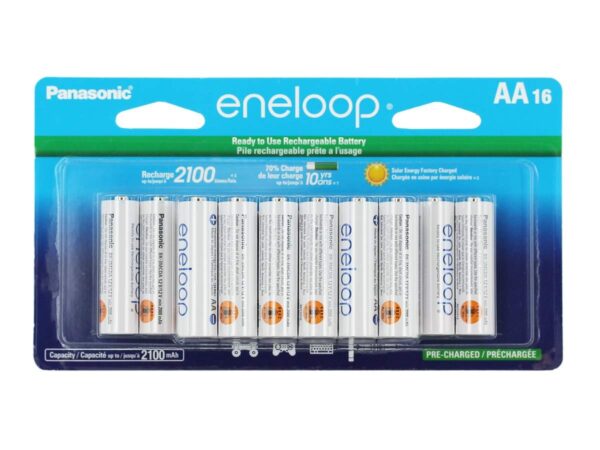
Sixteen AA cells that come charged and stay that way. Panasonic’s eneloop is the low self-discharge nickel-metal hydride cell most often recommended for torches, radios and lanterns, precisely because it can sit in a drawer for years and still work when you reach for it.
Key features
- Supplied charged, using solar power at the factory in Japan, so they work straight off the card.
- Holds about 70 per cent of its charge after ten years in storage, which is the whole argument for keeping them as spares.
- Rated for up to 2,100 recharge cycles, so a set bought once should outlast a great many alkaline packs.
- Keeps working down to minus 20 degrees Celsius, which suits a torch or radio left in a cold car or shed.
- Sixteen cells will fill a head torch, a hand torch, a radio and a lantern with a set still in reserve.
Specifications
- Chemistry: nickel-metal hydride (NiMH), 1.2V per cell
- Capacity: up to 2,100mAh, as printed on the pack
- Cycle life: up to 2,100 recharges
- Charge retention: about 70 per cent after ten years in storage
- Cell size and weight: about 50.4 x 14.4mm, 27g
- Pack: 16 AA cells, made in Japan
Two honest notes. A NiMH cell sits at 1.2V rather than the 1.5V of an alkaline; most equipment does not care, but a few devices that watch voltage closely will read a perfectly good eneloop as flat. And the card carries two different 2,100 figures, one for recharge cycles and one for capacity in milliamp-hours, which are easily mistaken for each other. No charger is included, and these need a NiMH charger.