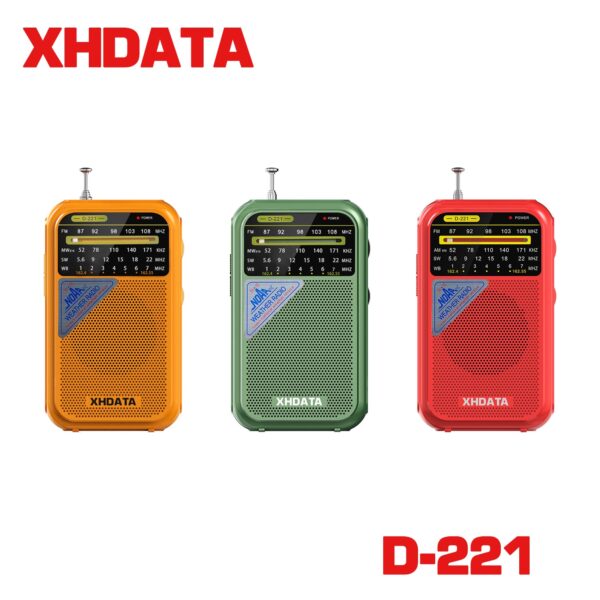
The D-221 is a deliberately simple radio. There is a dial, a volume knob and a band switch, and behind them four bands: FM, medium wave, shortwave from 5.6 to 22 MHz, and the NOAA weather channels. For a preparedness kit the appeal is that shortwave keeps working when local stations are off air, and that the whole thing costs little enough to keep one in each vehicle.
Key features
- Four bands: FM, medium wave, shortwave and the NOAA weather band
- Shortwave coverage from 5.6 to 22.0 MHz for distant broadcasts when local transmitters are down
- Analogue dial and three controls, so anyone can work it without the manual
- 3.5 mm stereo earphone socket
- Light enough at 6.4 oz to live permanently in a bag
- Runs on two ordinary AA cells
Specifications
- FM 87 to 108 MHz; MW 520 to 1730 kHz (10 kHz) or 522 to 1728 kHz (9 kHz)
- SW 5.6 to 22.0 MHz; WB 162.400 to 162.550 MHz
- Power: 3 V from 2 x AA cells, not supplied
- Size 2.8 x 1.1 x 4.9 in; weight 6.4 oz
- 3.5 mm stereo earphone socket
- In the box: radio and user manual
Read this one carefully before you buy it as a weather radio. XHDATA’s own specification lists four bands, an earphone socket and nothing more: there is no S.A.M.E. county programming and no stand-by alarm, so this is a set you tune to your weather channel and listen to, not one that watches for a warning while you sleep. The weather band is only usable in North America. Cells are not supplied, and shortwave reception varies a great deal with the time of day and where you stand. If you want to be woken by a warning, buy a S.A.M.E. alert radio and keep this as the one that travels.